
Mid Side EQ: The 10-Second Mud Fix for your Master [081]
Learn how to fix a muddy electronic music mix by controlling low-mid side energy with mid side EQ. Improve clarity, punch, and focus in your tracks.

After mastering hundreds of electronic tracks, I’ve learned to listen for a specific problem that most producers overlook. When they struggle with a muddy mix, the culprit is rarely that the track is too narrow. More often, the mix is muddy because the wrong frequencies are spread too wide.
We all want our drops to feel huge. The logic seems sound: more width equals more excitement. But when width is added without control, the opposite happens. The punch softens, clarity drops, and the groove loses its focus. This is especially deadly in House and Techno, where tightness is non-negotiable.
Here is how to find the hidden mud - and fix it.
The Real Source of the “Fog”
The most common source of mud in electronic mixes is excessive low-mid energy in the side channel, typically between 150 Hz and 600 Hz.
These frequencies add body to the music, but when they spread too wide, they create a low-mid fog.
Cut them in Stereo: You remove weight from the entire track (bad).
Cut them in the Side Channel: You remove the haze while preserving the impact (good).
This distinction is small in theory but massive in practice. The clarity it brings is immediate.
How to Hear the Problem (The Diagnosis)
To make the right decisions, you can isolate the side channel. A standard stereo meter won’t show you this buildup. I recommend using Ozone EQ (or any EQ with a reliable Mid/Side solo function).
Step-by-Step:
Insert Ozone EQ on your master.
Switch the plugin to Mid/Side mode.
Solo the Side band only.
When artists first hear this, they are often shocked. You will likely hear wide reverb tails, pads masking transients, phasey bass layers, and percussion loops smearing the stereo field. That is your “mud.”
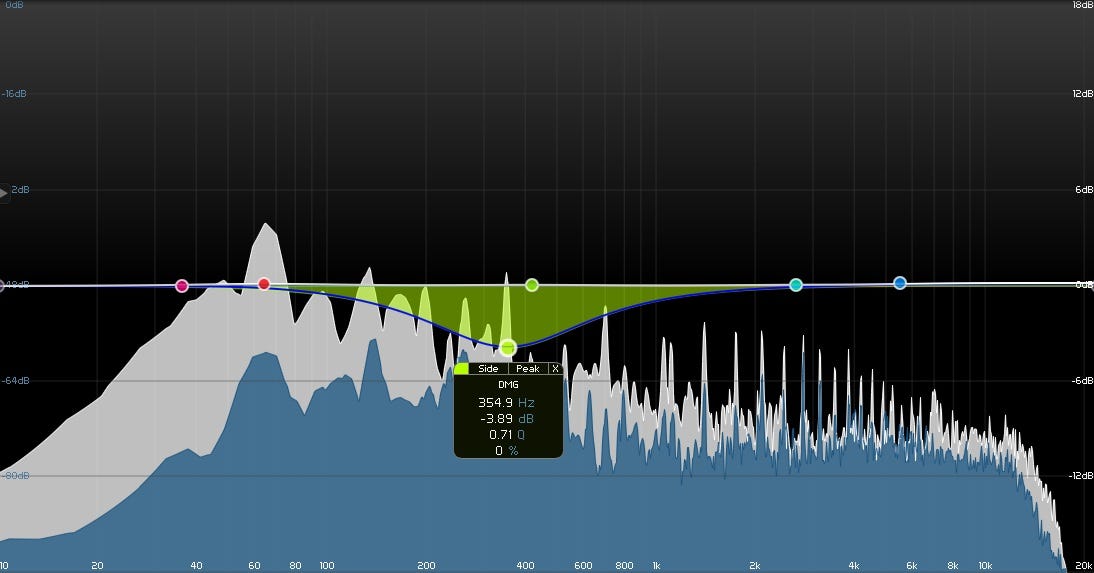
The Fix: Cleaning the Side Mids
Once you hear the problem, the solution is straightforward.
Find the Sweet Spot: To identify where the master is most sensitive, try boosting the low-mids on the Side channel by 6 dB first. This “search and destroy” technique makes it obvious which frequencies are cluttering the mix.
Static Cut: Once identified, a gentle bell curve reducing 1-3 dB in the 150-600 Hz range on the Side channel is often enough to instantly gain clarity.
Vocal Focus & Air: Apply a minimal cut between 2–4 kHz on the Side channel to unmask the lead vocal in the center. Pair this with a gentle high-shelf boost above 6 kHz on the Sides to add width and shimmer.
Dynamic EQ: If the mud only appears during specific chaotic moments, use a dynamic band to tuck it down only when necessary.
Protect the Center: Ensure you are leaving the Mid channel untouched to preserve the core punch of the kick and snare.
Beyond the “Mono Lows” Rule
Many engineers suggest simply low-cutting everything under 150 Hz to mono. While this helps stabilize the low end for club systems, it’s not a magic bullet. Instead of a strict rule, ask yourself: > Where does stereo energy enhance the music, and where does it weaken the punch?
Why Phase Matters: Wideners and unaligned samples introduce phase differences. This causes cancellation, making your kick lose shape and your bass feel soft. Side EQ stabilizes these interactions by controlling the width exactly where phase sensitivity is highest.
Pro Tip: The “Contrast” Technique
Want a massive drop without ruining your phase correlation? Stop trying to make the drop wider - make the build-up narrower.
Try slightly narrowing the stereo field in the bars leading up to the drop, then return to full width exactly at the impact point. This creates a natural contrast. The ear perceives the drop as explosive because it expands from a narrower frame. This delivers far more excitement than simply pushing a widener to 100%.
Need a Fresh Set of Ears?
Cleaning the side channel doesn’t remove width; it restores authority to the center. If you are unsure whether your mix has hidden side-range issues, I am always available to take a closer listen during a mastering session.
Let’s get your low-end tight and your stereo field focused.
Cheers, Marcus
Definitely going to investigate this in some current mixes, thanks!