
Wide stereo is making your track sound small 🎵🎶🎵 [086]
When you push the stereo field too far! The problem wasn’t that the vocal was too quiet. It was too wide to survive itself.

I remember a session where a client brought in what he called a “massive, wall-of-sound” vocal.
He had done everything the tutorials told him to do. He layered it. He pitched it. He added a heavy chorus. Then he pushed a stereo imager until the whole thing looked enormous on the screen.
In the sweet spot, on the studio monitors, it worked for a moment.
Then I did the boring check: mono, then a listen from outside the sweet spot.
The vocal didn’t just drop in level. It lost its chest. The center collapsed. What sounded like size in the room turned into something hollow and strangely distant.
The “width” he had built was really a web of phase cancellations pulling energy out of the performance.
That is the part people miss.
We often talk about mono compatibility like it is a boring technical chore. A checkbox for phone speakers, club systems, laptops, and all the other places music gets flattened after it leaves the studio.
But I don’t think of it that way anymore.
Phase correlation is not just about mono. It is about whether the impact you created actually reaches the listener.
When the left and right sides of a mix start fighting each other, the damage is not always obvious in a treated room. A sound can feel wide, shiny, and impressive in the sweet spot while quietly losing the pressure that makes it translate.
That pressure is where punch lives.
That is why a “big” chorus can suddenly feel smaller than the verse.
That is why a wide synth can make the whole track feel less forward.
That is why a vocal stack can look expensive and still refuse to sit in the record.
The meter is not the mix
A correlation meter will not tell you if a song is good.
It will not tell you if the emotion is right.
But it will show you something your ears can miss when the stereo image is flattering you: where the energy becomes fragile.
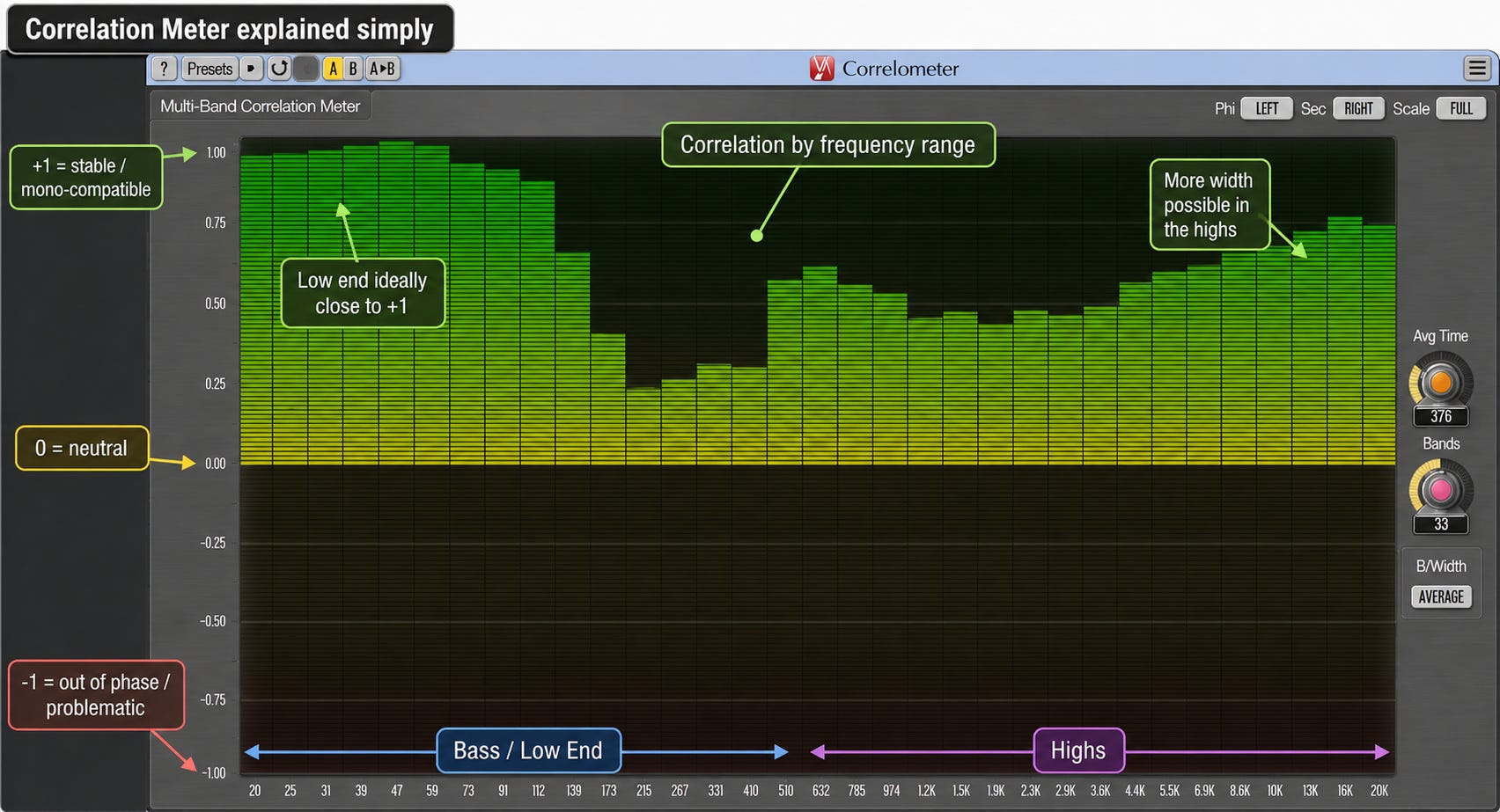
If the meter sits close to +1, your left and right channels are working together. You have a stable center. The sound will usually survive better across different playback systems.
If it keeps dipping below 0, something is working against itself. That does not automatically mean the sound is wrong, but it does mean part of the signal may disappear or weaken when the mix is summed, heard off-axis, or played through a narrow playback system.
That is not a small detail.
That is the difference between width that supports the song and width that steals from it.
Look by frequency, not just globally
The biggest mistake is watching one correlation bar for the whole mix and thinking you understand the problem.
You usually don’t.
That is why a multi-band phase tool, like Voxengo Correlometer, is so useful. It shows you the phase relationship by frequency range instead of giving you one averaged reading.
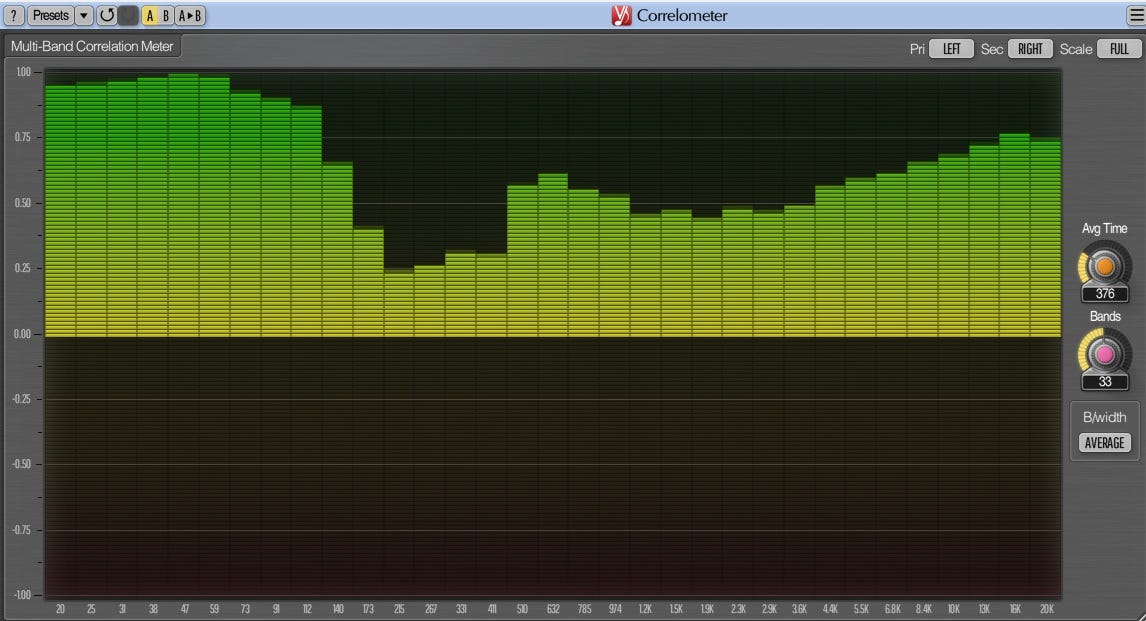
The low end is where I am strict.
Below roughly 200 Hz, I want the mix to feel solid and positive. Not necessarily perfectly mono in every case, but stable. If the sub and low bass are wandering out of phase, the track loses the physical thump you expect on a club system, PA, or larger speaker setup.
Low-end width rarely adds size. More often, it pulls focus away from the center.
Higher up, I give myself more room.
A little phase movement in the air frequencies can feel beautiful. It can create that wrap-around sensation around vocals, pads, guitars, reverbs, and delays. Some productions need that movement.
But there is a difference between width around the edges and a hole in the center.
That is the line I watch for.
Use it to find leaks, not to make everything safe
Do not chase a perfect +1 across the whole mix.
That usually means you have made the record Mono or narrower than it wants to be.
The better question is: where is the mix leaking energy?
If I see a big dip between 300 Hz and 800 Hz, I start looking at guitars, synths, stacked vocals, or stereo effects that may be too wide for their own good.
I do not immediately mute the vibe. I just pull the width back, change the chorus, adjust the stereo spread, or check whether one side is fighting the other.
And very often, something interesting happens.
The mix feels louder without touching a fader.
The vocal steps forward.
The guitars get denser.
The chorus hits with more weight.
Not because I added energy.
Because I stopped losing it.
Width is only impressive when the center can carry it.
Final thought
Stop treating the correlation meter as a punishment device for mono compatibility.
Treat it as a density meter.
The goal is not to make every mix safe, narrow, or technically polite. The goal is to make sure the energy you push into the speakers is not disappearing before the listener feels it.
A wide mix should still move air.
If it only looks wide, it is not big yet.
Best,
Marcus - mastrng.com
What is one track you have worked on where the “width” actually made the song feel weaker?